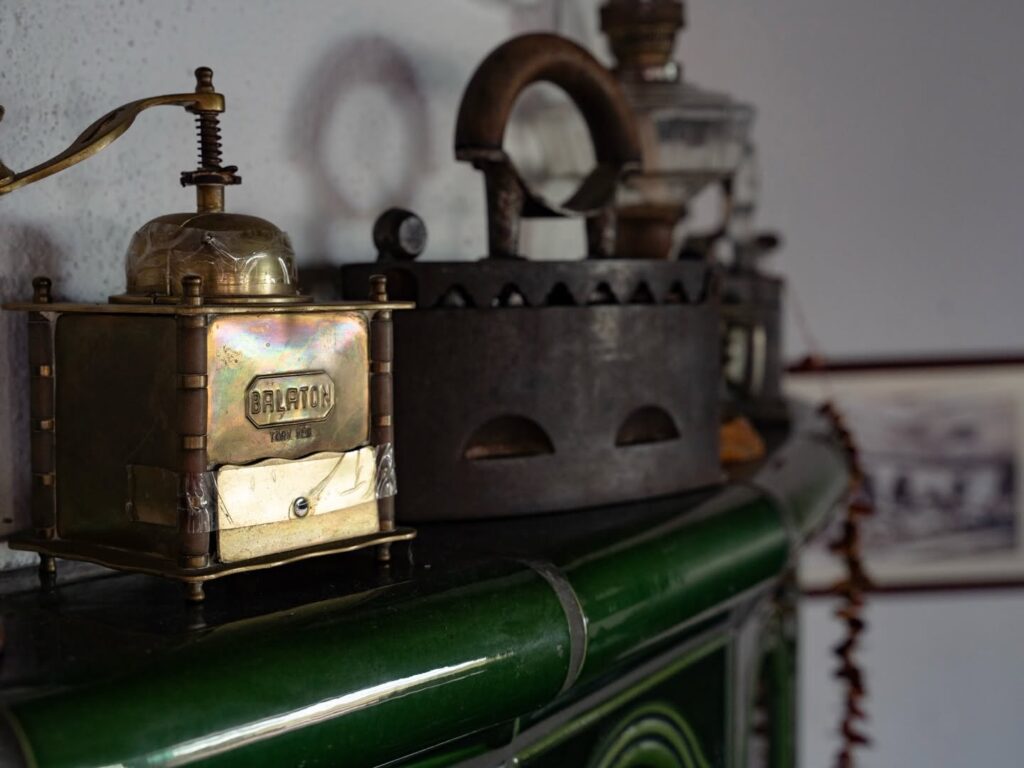
Halászcsárda, Keszthely: fisherman’s soup, Zala dödölle and nine decades by Lake Balaton
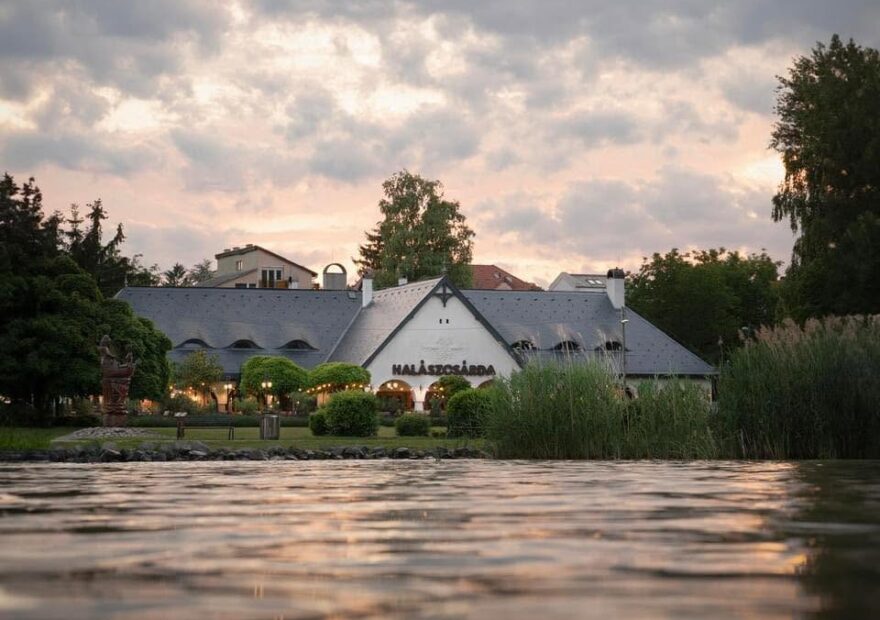
There is a restaurant in Keszthely whose story reaches far beyond a successful Balaton lunch. Beside Helikon beach, Keszthely’s Halászcsárda has been part of the town’s memory since 1934. Commissioned by the Festetics family and designed by a celebrated local architect, it once had traditional Roma music on its veranda, later lost its thatched roof to fire and fell silent for more than twenty years. Today, fisherman’s soup, roast pikeperch, catfish paprikash and Zala dödölle once again arrive at tables just a few steps from Balaton.
The appeal is not modern fine dining but the atmosphere of traditional inns: arches, garden seating, air from the lake, Hungarian dishes and occasional live music. Come with time for both a meal and a lakeside walk. Guest opinions are not unanimous, however: many love the building and surroundings, while the fisherman’s soup and service can divide visitors quite sharply.
1934: when the Festetics family commissioned a lakeside inn
Halászcsárda opened on 24 June 1934. It was commissioned by the Festetics family, with Prill Gyula as its first operator. Keszthely architect Svastics Géza designed it after the inns of Hortobágy. The columned veranda and original thatched roof were more than decoration: they represented a world of lakeside hospitality of which little remains around Balaton.
The inn soon became popular with holidaymakers and locals. For decades it appeared on postcards, family photographs and memories of celebrations; the music of well-known Keszthely Roma bandleader Árvai Tigris János once formed part of its evenings. While many Balaton restaurants have histories stretching back only a few decades, here you really can sit down in a local institution approaching a century old.
Fire, closure and a new life in 2012
The building’s fortunes were not always favourable. An accident in the 1980s destroyed the thatched roof by fire. Although it was later renovated, the inn soon closed and stood empty and deteriorating for more than twenty years. It increasingly ceased to resemble the restaurant once known across the country.
The turning point came with the Szita family’s involvement: restoration of the rescued building began in 2011, and Halászcsárda reopened in May 2012. Since then, an inn atmosphere preserving its original character, Balaton fish dishes and traditional Hungarian cooking have formed its foundations.
The story is special because this is not a newly invented restaurant borrowing an old name, but genuine architectural and hospitality heritage. The history within its walls remains interesting even for someone stopping only for a brief lunch.
Fisherman’s soup in Keszthely: the classic everyone has an opinion on
In a fisherman’s inn, Balaton-style fisherman’s soup is a natural starting point. Deep red paprika, hot broth carrying the aroma of fish and bread served alongside form a combination many associate with an entire Balaton holiday. The soup has long held an important place in the selection, and a report on the spring 2026 reopening also mentioned several versions.
This is precisely the dish for which expectations are highest. Some guests describe it as a recurring favourite, while others in recent years have found it too thin, underseasoned or disappointing for the price. We would therefore not unconditionally call it Keszthely’s best, but certainly present it as an important part of the venue’s culinary tradition.
If you are coming specifically for the soup, ask which fish is used in the current version. Nor should the fish’s origin automatically be linked to Balaton: a Balaton recipe and fish actually caught in the lake are two different things.
Crisp carp bites: a crunchy opening
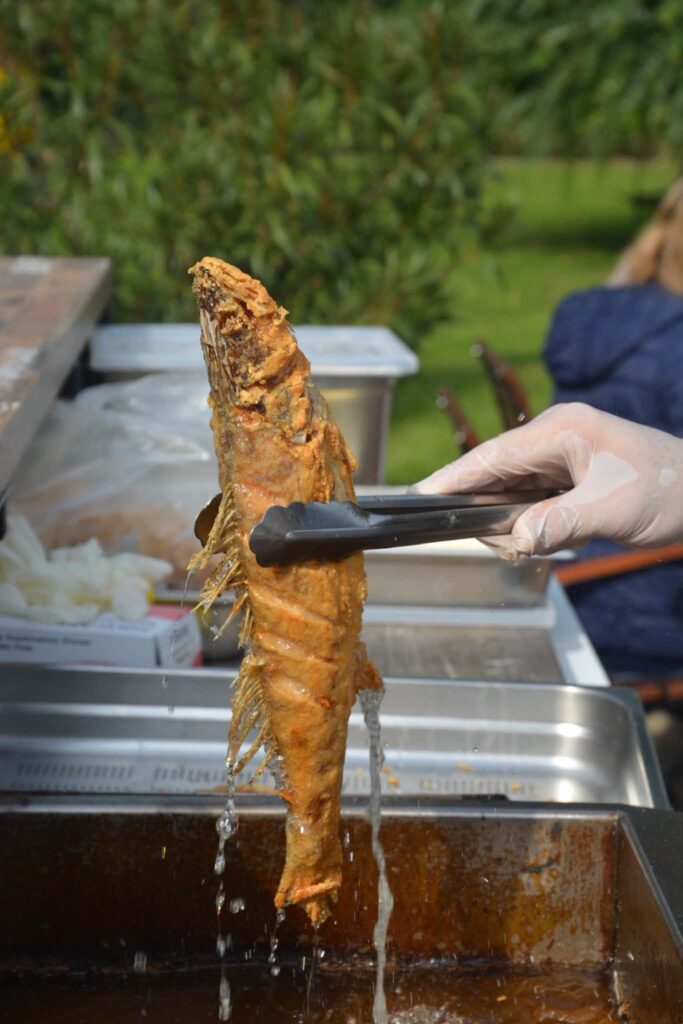
Alongside fisherman’s soup, crispy bites made from carp fillet are among the inn’s documented specialities. It is a simple idea whose success depends on detail. A carefully browned crust around small pieces and the tender fish beneath make the dish appealing.
For two or more guests, it can make a good shared starter. After the crisp fish bites, move on to rich paprika-sauced dishes or a more lightly prepared pikeperch fillet. Check the day’s menu for the precise accompaniment, dip and current availability.
Pikeperch fillet and fried pikeperch: one of Balaton’s best-known flavours
Among Balaton fish dishes, fogas and süllő, both names for pikeperch, hold a particularly distinguished place. Its white, fine-textured flesh shows best when not weighed down with unnecessary breadcrumbs or too much sauce. Pikeperch fillet is documented in Keszthely Halászcsárda’s offering, while the October 2026 garden fish fry featured freshly fried pikeperch and crisp bream.
It is worth distinguishing the regular restaurant selection from special fish-fry menus. Freshly fried whole or portioned pikeperch may be part of an event’s atmosphere, without necessarily being available in the same form on an ordinary weekday. When it is available, it can be one of the best and simplest choices for a lakeside lunch.
Catfish paprikash: creamy sauce and Hungarian character
Catfish paprikash represents the richer, fuller-flavoured side of Hungarian cooking. In a well-made version, the fish is tender and the paprika-and-sour-cream sauce silky, leaving a little sauce after every bite that encourages another forkful of the accompaniment. It has long been a familiar dish in Halászcsárda’s offering.
Not every guest wants crisp, whole fried fish. For someone who enjoys the saucy dishes of traditional Hungarian cooking, catfish paprikash is an obvious alternative. Always check the current accompaniment and portion size on site, however; we do not claim it is invariably served with túrós csusza pasta or dödölle.
Zala dödölle: when a simple side dish acquires its own story
There is a less obvious leading character in Halászcsárda’s story: Zala dödölle. Potatoes, flour, salt and water. Even these few ingredients can create a dish with a following of its own. Pieces shaped from the mixture are traditionally browned in fat and often eaten with onion, sour cream or bacon.
Owner Szita Gábor and his team also produce dödölle in larger quantities in connection with the restaurant. Their product reaches hotels and Hungarian retail shops. SPAR’s Régiók Kincsei programme separately showcases Szita Gábor’s Zala dödölle.
We Love Balaton explored the story in detail: in summer 2025, its journalist sampled well-browned dödölle with sour cream, bacon and onion at A Szitakötő, the seasonal venue in the inn’s courtyard. An important distinction is that this particular plate appeared in a report about the courtyard venue, not necessarily as a permanent dish on Halászcsárda’s full menu.
If you want not just fish by Balaton but a genuinely local Zala flavour, dödölle has special significance here. Its soft interior, browned surface, cool creamy sour cream and onion’s sweet-savoury character form a combination that says a great deal with very few ingredients.
Rural classics instead of fish: goulash, pork knuckle and strudel
The inn’s menu is not built solely around fish. According to Keszthely’s tourism introduction, earlier selections also included steak tartare, beef goulash, Zala dödölle and crisp pork knuckle. For a sweet finish, it mentions Gundel pancakes and homemade hand-stretched strudel.
Such dishes are not minor characters in an inn’s story. At a large family table, one person may want fisherman’s soup while another prefers good pork knuckle or a traditional Hungarian main. Halászcsárda tries to accommodate many kinds of guest, an advantage for mixed groups, although reviews suggest the kitchen’s standards are not equally convincing for every dish and every visit.
Live music, a columned veranda and lakeside garden seating
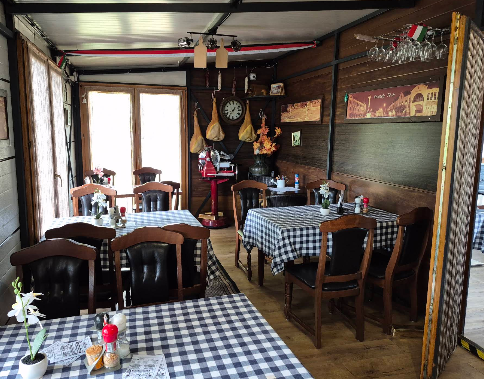
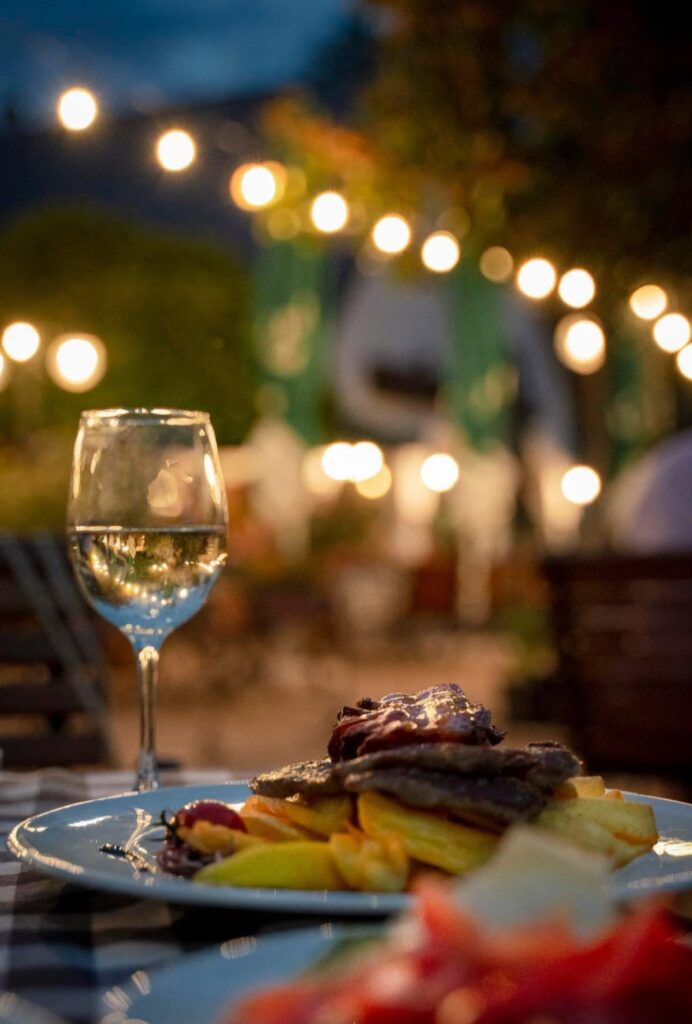
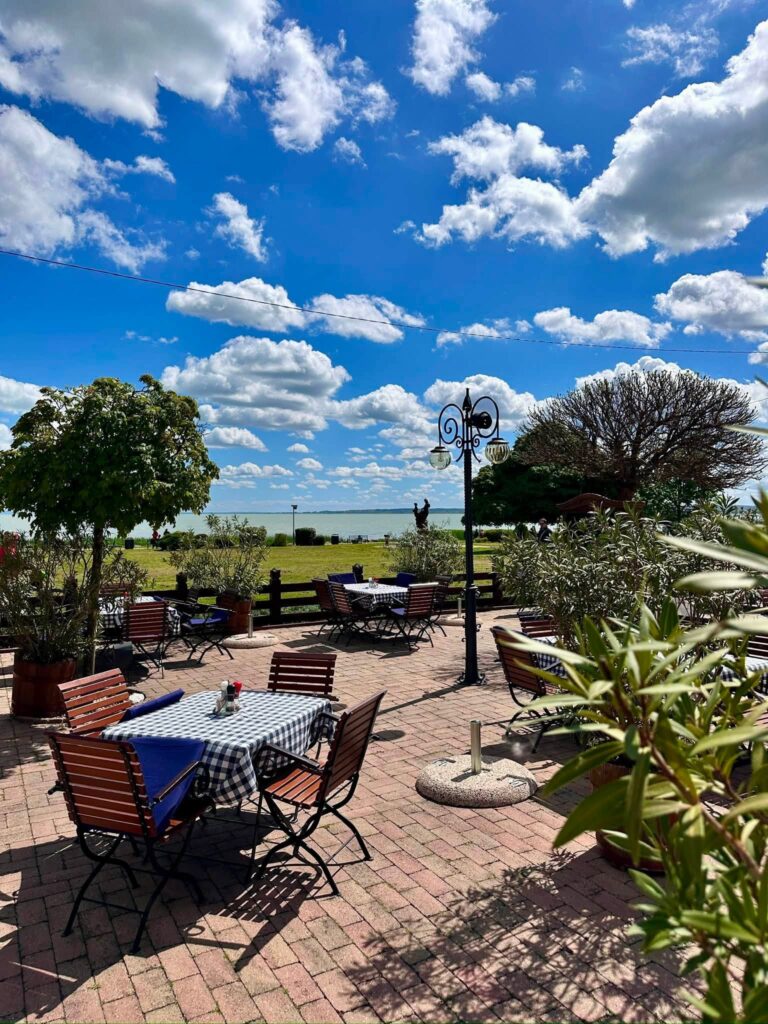
A true inn atmosphere is not created on the plate alone. At Keszthely’s Halászcsárda, arched spaces furnished with wooden furniture and the terrace matter just as much as the kitchen. Balaton’s proximity is tangible: Helikon beach is roughly fifty metres away, and the area suits both walking and cycling.
The musical tradition is not known only from old postcards. In summer 2026, the inn advertised live music on Friday and Saturday evenings and at Sunday lunchtime; autumn fish-fry events also had musical accompaniment. This depends on the programme and season, so check musical dates before setting off.
At the garden’s best tables, Balaton is part of the experience. In summer, however, a lakeside setting can also bring mosquitoes and wasps, mentioned in both some older and more recent reviews.
Szita Gábor and Halászcsárda’s second life
When a long-empty building reopens, we tend to see the end of the story. Yet the harder work often begins only then: how does a renovated past become a hospitality business that works today?
The Szita family played a decisive role. In 2024, owner Szita Gábor spoke in detail about the inn’s ninety-year history, preserving traditions, musical occasions and dödölle’s development into a product in its own right. The last point is particularly interesting: a simple Zala dish made its way from the restaurant kitchen to a wider national audience.
In 2025, the owner personally demonstrated dödölle-making to the We Love Balaton team. Traditional ingredients and hand-shaping remained important even at larger production volumes.
Halászcsárda therefore has a genuine human story: someone rescued an old building, reopened it and developed a local culinary product connected with the restaurant. This does not automatically make service or cooking flawless, but shows why it is more than a simple restaurant beside a beach.
What do guests say? Praise and unpleasant experiences
Keszthely Halászcsárda’s public reputation is mixed. At the time of research, Tripadvisor showed 3.8/5 from 165 reviews, and Ittjártam.hu 3.4/5 from 21. The samples do not use identical methods or cover identical periods, but this is certainly not a universally praised venue.
Positive accounts are dominated by the waterfront location, atmospheric building, generous portions and friendly service. A summer 2026 Tripadvisor guest particularly praised the fish dishes and local wines, while a September visitor highlighted the friendly welcome and a menu offering fish, meat and vegetarian choices.
Others left with very different experiences. In recent years, several have criticised the fisherman’s soup’s flavour, dish temperatures or preparation, the tone of service and value for money. A September 2026 guest reported being unable to order dinner before the advertised closing time; a June visitor objected to lights and music being switched off close to closing. These are individual experiences, not proof that the venue operates this way on every occasion, but it would be unfair to conceal the reports.
The best conclusion is not that Halászcsárda is necessarily good or bad, but that its historical and atmospheric appeal is stronger and more predictable than the guest consensus on its food. BalatonEats should make this distinction clear.
A family lunch, cycling outing or celebratory event
Being next to Helikon beach can make Halászcsárda convenient for families, cyclists touring the lake and those seeking a quieter waterfront setting instead of the town-centre bustle. The cycle route passes nearby, and according to the restaurant, free parking is available. The railway and bus stations are also within roughly five hundred metres.
The restaurant is equipped for more than lunches for two. It can host family, corporate or wedding events for up to 150 people, with a separate room and projection facilities. Larger groups should make arrangements ahead, as group meals and musical programmes can affect normal restaurant traffic too.
After eating, a lakeside walk can be pleasant, particularly towards the wooden sculpture recalling the Balaton legend of Helka and Kelén. Lunch can thus easily be combined with a short, relaxed Keszthely outing.
Worth a taste
Crispy carp-fillet bites
Because in a fisherman's inn built in 1934, discovering traditions matters as much as lunch itself. The Festetics family's heritage, lakeside garden, fish specialities and locally made Zala dödölle give the restaurant a character that a newly opened venue cannot create overnight.
Local tip
Do not miss the dödölle!
Start with crispy fish bites, then ask about the current fish dishes and homemade Zala dödölle. If a version with sour cream and browned onions is available, it is worth trying, even as a dish on its own. At weekends, ask about live music in advance, and before dinner check the kitchen's last-order time.
The BalatonEats meal plan
How to put your meal together
- 01Crispy carp-fillet bites
Small carp bites served hot, with a browned, crunchy crust and tender flesh. This kind of starter needs no special technique or spectacular presentation, just good ingredients and careful frying. A lighter opening than a full portion of fisherman's soup, leaving room for the next courses.
- 02Venison with Zala dödölle
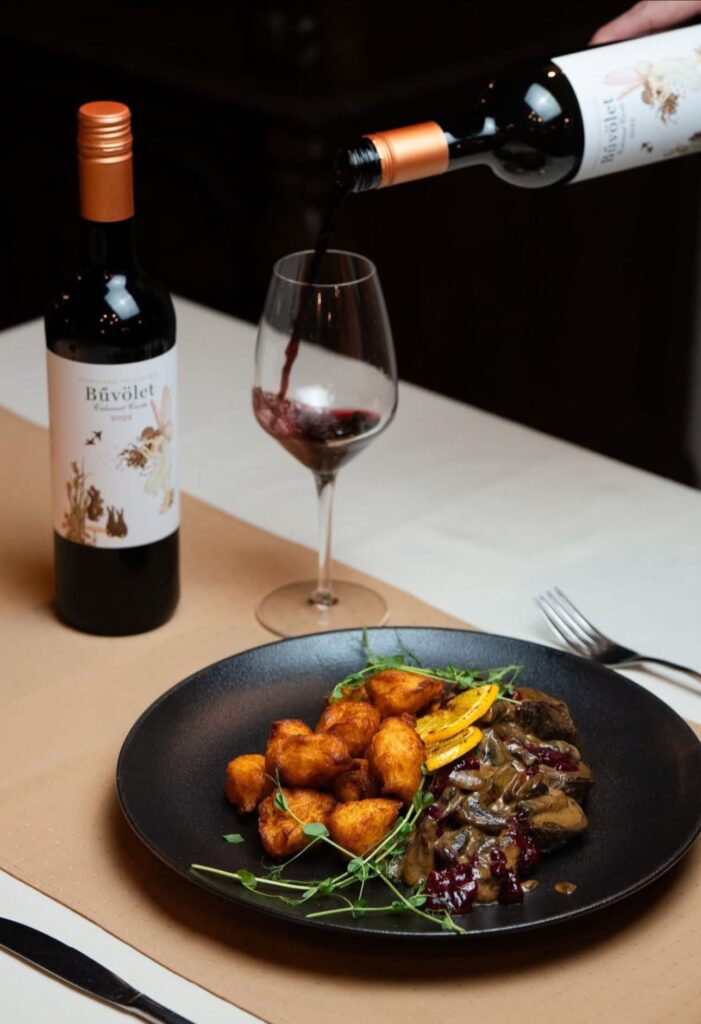
The previously documented venison dish and homemade dödölle make an intriguing pairing: substantial, deeply flavoured game alongside potato bites browned outside and soft inside. Dödölle goes particularly well with thick, rich gravy. This combination reveals the inn's Zala side, provided it is available in the current selection.
- 03Homemade hand-stretched strudel
Thin, delicately crisp pastry layers, a generous filling and a little icing sugar. The most appealing thing about a well-made strudel is its simplicity: it does not pretend to be more than it is. Halászcsárda's homemade strudel-making is also connected with the owner's separate food business, making this dessert a particularly fitting finish to a tasting.
What guests say
What stays with guests?
Halászcsárda's reputation is more complex than the old building and beautiful setting initially suggest. A substantial share of guests praise the atmosphere, terrace and traditional hospitality, and many report tasty fish dishes and friendly service.
However, the criticisms are notably not confined to old experiences that may no longer be relevant. Reviews from 2026 also include distinctly negative accounts, particularly concerning fisherman's soup and service.
Overall, the historic surroundings are Halászcsárda's most dependable strength, while the culinary experience is less predictable. I would therefore recommend it primarily for its character, Balaton traditions and the opportunity for a leisurely lakeside meal.
+
What brings people back
- Lakeside location: the peaceful garden and proximity to Balaton are among the most frequently praised features.
- The historic building: arches, carved furniture and a traditional inn atmosphere give many guests a special experience.
- Traditional fish dishes: several guests were particularly happy with the fisherman's soup, fried fish and assorted fish platters.
- Generous portions: several reviewers praise the quantity of the larger fish and meat dishes.
- Live music: musical lunches and evenings can evoke a distinctive, old-fashioned Balaton atmosphere.
!
Good to know before you go
- Insects on the terrace: summer visitors have found wasps or mosquitoes bothersome.
- Disputed value for money: some guests feel food quality does not always justify the final bill.
- Inconsistent fisherman's soup: complaints in several different years concern its flavour, thickness or the fish's texture.